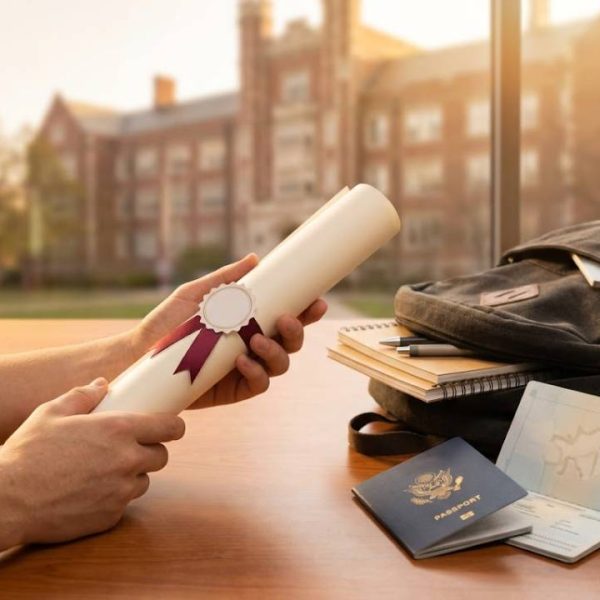
Applying to a university abroad involves far more paperwork than most students expect. Beyond the application form there are transcripts and diplomas and recommendation letters and proof of language ability and often a birth certificate or a financial statement. Each of these documents has to be understood by an admissions office that may not read the language it was written in. Students who start collecting and translating papers late often discover that the real deadline is not the application date but the time it takes to prepare everything properly.
Admissions staff see the same problems every year. A transcript arrives with grades that follow a national scale nobody on the committee recognizes. A diploma is translated word for word without any explanation of what the qualification actually allows its holder to do. A document is submitted as a plain photocopy when the university asked for an official version with a stamp. None of these errors reflect on the ability of the student. They reflect how unfamiliar the process feels for someone doing it for the first time.
Different universities also follow different rules. One institution accepts a translation prepared by any qualified professional while another insists on a sworn or certified version. Some ask for the original document and its translation to be sent together while others only need a scan at the application stage and the paper copies after admission. Reading the instructions carefully and asking the admissions office when something is unclear saves weeks of delay and avoids paying for the same document twice.
Families who help a student apply abroad often underestimate the emotional side of the process. A rejected document at the last moment can feel like a rejection of the student. In reality it is nearly always an administrative issue that can be solved with the right version of the paperwork. Calm planning and a clear checklist turn a stressful scramble into a manageable series of small tasks that can be completed one at a time over several weeks.
Timing is the factor that students underestimate most. A certified translation may take several working days and obtaining an official copy of a diploma from a school archive can take weeks. Add postal delays and a student who begins in the final month before a deadline is gambling on every step going perfectly. Starting at least three months ahead gives enough room for corrections and for the unexpected requests that universities sometimes send after reviewing a file.
For students juggling multiple applications, working with professional document translation services simplifies the entire process. These providers handle transcripts, diplomas and financial statements with the formatting and certification that universities require. They also track changing requirements across institutions, so a translation accepted by one university won't be rejected by another. Starting this step early is the easiest way to avoid deadline panic.
Why Official Documents Need A Qualified Translator
Students from Eastern Europe and Central Asia often need a reliable russian document translation service because school records and civil documents in that region follow formats that Western admissions offices rarely see. A translator who understands both the source system and the target university can render grades and stamps and course names in a way that the reader can interpret without guessing what each line means.
A good translator also flags problems before submission. A missing stamp or an unclear signature or a date that does not match another document can be fixed early if someone notices it. Admissions staff often have no time to write back with questions and may simply set an incomplete file aside. Catching those details in advance protects the student from a silent rejection that arrives weeks later with no explanation.
When A Certified Version Is Required
Many universities and immigration offices ask for a stamped version of key documents. For diplomas and transcripts and legal records that usually means working with a provider of certified legal translation services who can attach a statement confirming the translation is accurate and complete. That statement is what gives the document weight with an official reader and separates it from an informal translation done by a friend or a free online tool.
Students sometimes assume that any translation will do and then learn the hard way that an uncertified version has to be redone. The cost of paying twice is usually small compared with the cost of missing a deadline. Checking the requirement before ordering is a five minute task that prevents most of these problems. It also helps to ask the provider how many copies are included and whether an electronic version is accepted.
Student files contain some of the most sensitive personal data a person ever shares: grades, financial statements, passports and medical records. Professional document translation services treat this material with the same care as legal or corporate filings, using secure transfer, restricted access and clear data-handling policies. That matters because a translated transcript can pass through several hands before it reaches an admissions office. Choosing a provider that protects confidentiality as well as accuracy keeps private information from becoming a second problem.
What International Research Says About Student Mobility
Reports from the OECD show that the number of students studying outside their home country has grown steadily over the past decades. That growth means admissions offices now handle documents from many more education systems than they once did and clear presentation matters more than ever.
Economists at the International Monetary Fund have also discussed how education and skills shape long term economic outcomes for individuals and countries. For a student the lesson is practical. A degree earned abroad is an investment and the paperwork that supports it deserves the same careful attention as the studies themselves.
A Practical Checklist For Applicants
Begin by listing every document the university requests and the format it expects. Order official copies early from the issuing school or authority. Decide which papers need certification and which only need a standard translation. Keep digital scans of everything in a single folder with clear file names so that nothing gets lost when a university asks for an item a second time.
Build a simple calendar with a date for each document and add a buffer of at least a week before the real deadline. Share it with whoever is helping with the application. Review each translated page against the original before sending it and confirm that names and dates and numbers match exactly. Small mismatches in spelling are one of the most common reasons for a request to resubmit.
Students who treat the paperwork as part of the learning experience tend to arrive at their new university calmer and better prepared. They have already practiced planning and communicating across languages and solving problems with an official office. Other applicants preparing to study abroad would do well to start early and ask questions often and treat every document as an important part of their future education.